If you're reading this, you're probably somewhere between "just diagnosed" and "already had the mastectomy" — and the good news is where almost nobody looks: breast reconstruction is legally protected, medically mature, and more natural-looking than it has ever been.
This guide walks through the entire reconstruction decision space: implant-based (expander-then-implant and direct-to-implant) versus autologous (DIEP, TRAM, latissimus and PAP flaps), immediate versus delayed timing, what radiation does to your choices, the WHCRA insurance guarantee, costs (see our NY/NJ reconstruction cost guide), and the finishing stages of nipple reconstruction and 3D tattooing. If you haven't read it yet, our mastectomy vs lumpectomy guide is the companion piece that covers the removal side — and the reconstruction recovery timeline maps the healing side.
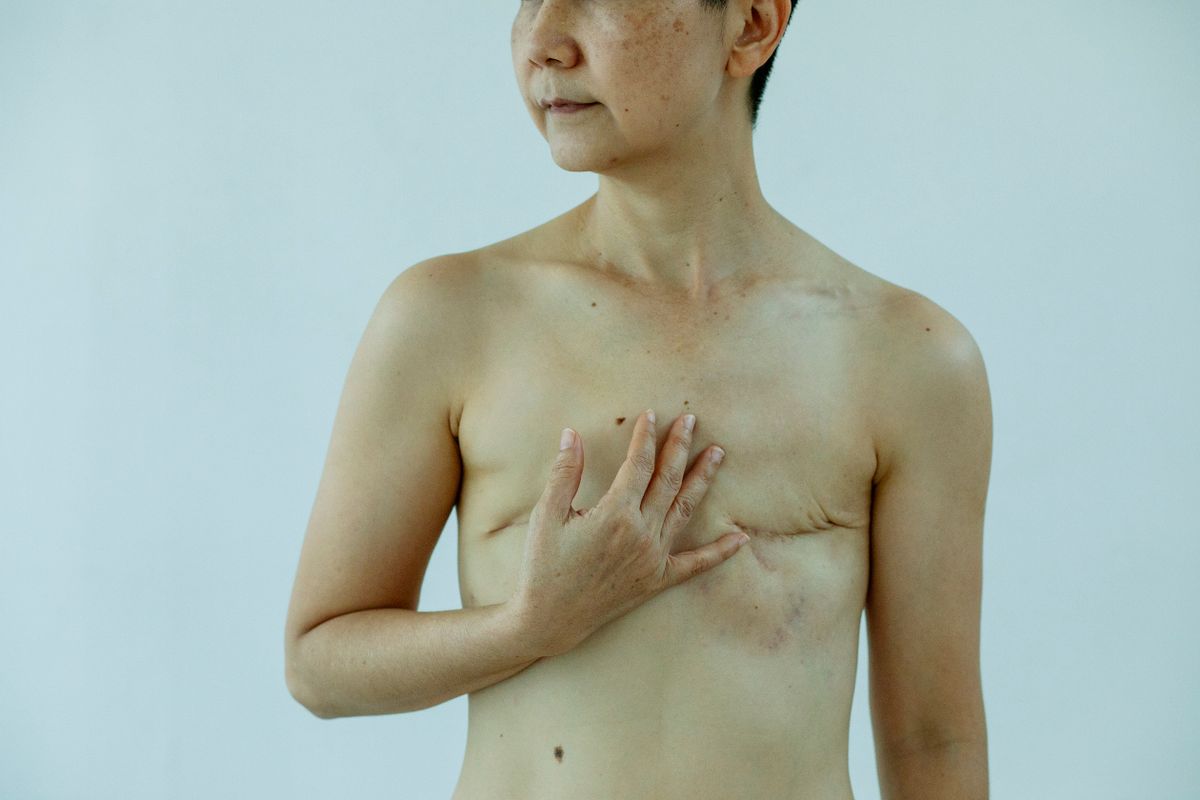
1. What Breast Reconstruction Is (and What It Guarantees)
Breast reconstruction rebuilds a breast mound after mastectomy using either an implant or your own tissue. It does what it says on the tin, and two things need saying early:
- It is a process, not a single surgery — most patients have 2-4 planned stages over 6-18 months, ending in nipple reconstruction and tattoo.
- It is covered. The federal Women's Health and Cancer Rights Act (WHCRA) has required since 1998 that any insurer covering mastectomy also cover all stages of reconstruction on both breasts — including symmetry work on the opposite breast — whether reconstruction is immediate or years later.
You are never obligated to decide at the time of mastectomy. WHCRA exists precisely so you can decide now, later, or never.
2. Implant-Based Reconstruction
Two-stage: tissue expander → implant
The classic pathway. At mastectomy (or later), the surgeon places a temporary tissue expander under the chest muscle. Over 2-6 weeks of clinic visits it's inflated gradually with saline to stretch the skin; then, in a second surgery 2-6 months later (usually after radiation or chemo finishes), the expander is exchanged for a permanent silicone (or saline) implant.
Direct-to-implant (DTI)
A permanent implant is placed in one surgery. Best for non-smokers with smaller breasts wanting smaller implants, and generally less expensive over the full episode of care — published episode averages run about $13,700 for direct-to-implant versus $16,600 for the expander path. The trade: the skin must be healthy enough to accept a full implant immediately.
Implant pros: shorter operations, faster initial recovery, no donor-site wound. Cons: it's a device (eventual replacement), needs monitoring, can capsulate, and — critically — is fragile in the face of radiation.
3. Autologous (Your-Own-Tissue) Reconstruction
| Flap | Donor site | Strengths | Recovery |
|---|---|---|---|
| DIEP flap | Lower abdomen (muscle-sparing) | Most natural-feeling and permanent; doubles as a tummy tuck; 96-99% success | 6-8 weeks; 6-8 hour surgery |
| TRAM flap | Lower abdomen (uses muscle) | Similar result to DIEP with slightly higher abdominal-wall trade-off | 6-8 weeks |
| Latissimus dorsi flap | Upper back | Reliable, good for radiated chests; usually paired with a small implant for volume | 4-6 weeks |
| PAP, SGAP/IGAP flaps | Thigh, buttock/gluteal crease | Options when the abdomen can't be a donor | 6-8 weeks |
The DIEP flap is the modern gold standard of autologous work: microsurgeons take skin and fat from the lower belly with their blood vessels intact and reconnect them to chest vessels under a microscope — no abdominal muscle is removed, so core strength is preserved. If you're researching, you'll find heavy demand for DIEP flap specialists in New York and New Jersey; the region has some of the busiest microsurgery teams in the country.
4. Immediate vs Delayed Reconstruction
- Immediate: same operation as the mastectomy, one recovery period, and the skin envelope is preserved at its best. The catch: the plan must be fairly certain radiation won't follow — because radiation is hardest on fresh implants and flaps.
- Delayed: months to years later. Preferred when radiation is planned, when you want the mastectomy to heal and pathology to settle first, or simply when you want breathing room. WHCRA covers it fully either way.
5. Nipple Reconstruction and 3D Tattooing
The mound is the first half; the finishing touches are the second. After the breast settles:
- Nipple reconstruction — a small local flap raises a nipple projection that has no underlying gland. This is a short clinic surgery.
- 3D areola and nipple tattoo — pigment adds areola color, with an artist's shading that creates the illusion of a raised nipple even years later. Many patients now choose 3D tattooing without the surgical nipple — the tattoo alone can look remarkably dimensional.
- Both stages are routinely covered under WHCRA as part of reconstruction.
6. Reconstruction Risks
- Implant route: capsular contracture, rupture (device life ~10-20 years), malposition, infection; materially worse with radiation.
- Flap route: microsurgical reconnection failure (rare, 1-4% depending on series), partial fat necrosis, donor-site complications (seroma under a DIEP incision, abdominal bulge after TRAM), long recovery.
- Any route: anesthesia risk, bleeding, asymmetry, need for revision, and — with radiotherapy — delayed wound healing.
7. Costs in 30 Seconds
Under WHCRA, reconstruction is an insured procedure in the US — the deductibles and co-insurance you see are typically far smaller than the self-pay bills (published episode averages: ~$13,700 direct-to-implant, ~$16,600 expander path, DIEP flap commonly running $35,000-$70,000+ before insurance). In New York and New Jersey, network-credentialed reconstruction teams and centers are plentiful — from Manhattan to Hackensack — so geographic access is rarely the constraint; cost transparency is. Our 2026 reconstruction cost guide walks you through the real patient bill.
Whatever you choose, the process is your process — armed now with the map, read the recovery timeline, compare teams through our breast surgery services and every breast guide, and pair it with the mastectomy-side surgery guide.
FAQ — Quick Answers
What's the difference between implant and DIEP flap reconstruction? Implants are a shorter, staged device pathway; a DIEP flap uses your own abdominal tissue, feels most natural and permanent, but is a 6-8 hour microsurgical operation with a 6-8 week recovery.
Can reconstruction happen with my mastectomy? Yes — immediate reconstruction is common; delayed is the strong choice with planned radiation or when you prefer more time. WHCRA protects both.
Does insurance cover reconstruction? Yes — WHCRA mandates coverage of all stages on both breasts, plus symmetry surgery on the opposite side, immediate or delayed.
Does radiation damage implants? It raises implant failure sharply (17.5% vs 2.0% loss at 12 years in a large cohort) — flap reconstruction is usually favored when radiation is planned.
What is a DIEP flap and its recovery? Your lower-abdominal skin and fat moved to the chest with microsurgery; it doubles as a tummy tuck, succeeds 96-99% of the time, and asks for 6-8 weeks of recovery.
What are nipple reconstruction and 3D tattoos? A small flap builds nipple projection, and tattooing adds areola color — including dimensional 3D shading that many women choose as their only finishing step. Both are covered by insurance in the US.